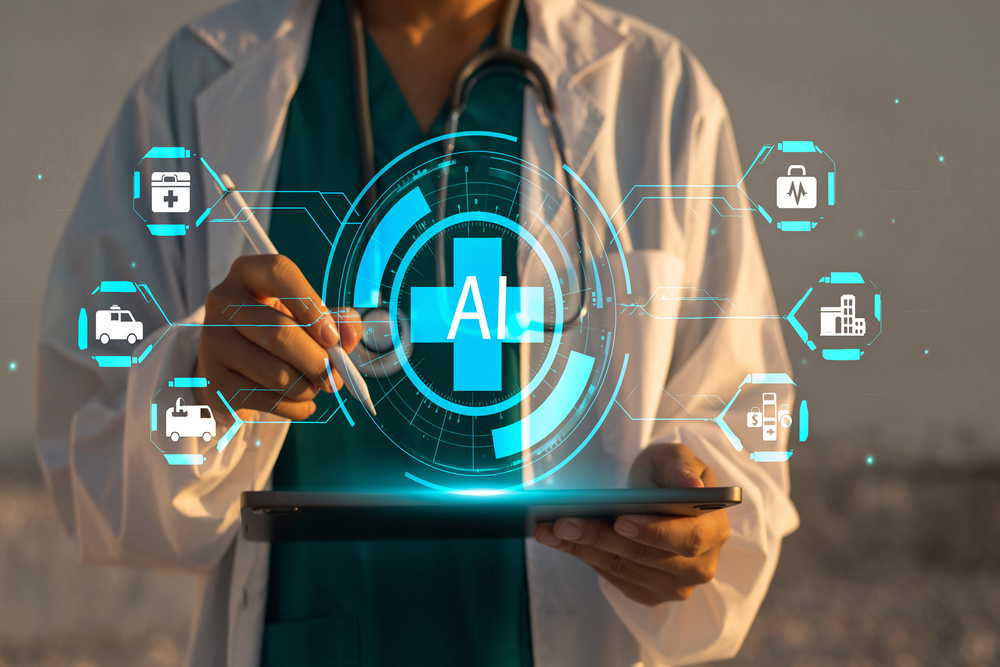

Summary: AI is nearly everywhere, including healthcare. As the healthcare sector adopts more AI technologies, clinical professionals will have to learn how to use them. ProTrain AI healthcare courses are already bringing nurses and medical assistants up to speed.
The healthcare industry is currently undergoing the most radical transformation it has seen since introducing electronic health records (EHRs). Technology is once again part of the transformation. But this time, the driving force is not a new application or an improved user interface. It is artificial intelligence (AI). From hospital wards to outpatient clinics, AI tools are turning clinical practice on its head.
For nurses, medical assistants, and other frontline healthcare professionals, the shift is monumental. Not only does AI change the way clinical professionals work, but it opens the door to incredible opportunities for career advancement. Yet the AI revolution has also introduced anxiety. There is an underlying worry that plagues many healthcare professionals: will AI replace me?
Here is the most important thing to know: AI is not replacing human healthcare professionals. It cannot. Instead, healthcare professionals comfortable using AI are replacing those who are not. That suggests career advancement is heavily dependent on specialized AI training courses.
AI in healthcare is here to stay. That’s good because it is helping clinical professionals pivot away from administrative work to concentrate on patient care.
AI on the Front Lines
If you are not sure why AI healthcare training is critical, consider how the technology is already changing daily workflows. You use AI in your personal life to some degree. Has it streamlined how you do certain things? Probably.
Frontline healthcare workers have historically borne the brunt of administrative burnout. It is no secret that nurses and medical assistants spend a good deal of their time documenting care and filling out insurance forms. They are tasked with managing tasks that minimize the amount of time they can interact with patients. So how can AI help?
AI is changing the dynamics on the hospital floor and in the clinical waiting room. Advanced technologies now being deployed across the healthcare industry are taking on the heavy load of data management:
- Documentation – AI-powered software and audio systems listen in on patient encounters and automatically generate drafts of clinical notes. They can also generate discharge summaries and referral letters.
- Predictive Monitoring – AI algorithms analyzing real-time vital sign data can predictively alert nurses and medical assistants to danger. Algorithms can predict things like sepsis and clinical deterioration long before physical symptoms appear.
- Triage and Scheduling – AI algorithms can sort all types of incoming patient communications. They can streamline triage, optimize clinical schedules, and even reduce no-show rates by following up with patients.
These types of things, and more, all add up to a more streamlined workflow in the clinical environment. When workflows are streamlined, medical professionals are not spending their days staring at computer screens and typing in data. The nurse or medical assistant can focus almost entirely on the human patients they must care for. But there is a catch: AI tools require baseline literacy. You need to understand them to use them properly.
How AI Courses Empower Nurses
Nurses are the backbone of Western healthcare. They are the ones keeping inpatient and acute care operations moving along. But because they maintain the most contact with patients, nurses are also the ones primarily tasked with using bedside AI technologies. AI nursing courses train nursing professionals on how to use AI for clinical applications. The courses do not teach writing code or developing algorithms.
Here are some examples of what AI training courses for nurses cover:
- Predictive Analytics – Nurses learn how AI predicts things like sudden cardiac arrest or patient falls. Once a nurse learns how to interpret predictive scores, she can better care for patients. But she doesn’t have to blindly accept the data. She can validate it with her own clinical assessment.
- Data and Ethics – AI courses can teach nurses how to safeguard patient data in light of HIPAA and other privacy concerns. Specialized training teaches nurses how to navigate automated tools without compromising patient confidentiality.
- Leadership Transitioning – Learning how AI works in a clinical setting positions a nurse for transitioning into leadership roles. Completing AI certification courses gives the nurse an advantage because she becomes an effective bridge between clinical staff and the IT department.
It cannot be overstated that AI courses for healthcare don’t require any knowledge of coding or software development. The point of the training is to teach nurses how to use AI tools effectively. How those tools work under the hood is not important to the nurse’s daily workflow.
How AI Is Redefining the Medical Assistant Role
AI for medical assistants is similar to AI for nursing in some ways, but different in others. That’s because medical assistants operate at the intersection of clinical care and administration. Their responsibilities are uniquely split in a way that seems perfectly suited to AI streamlining. Here are just some of the ways AI is redefining the medical assistant role:
- Documentation –AI frees medical assistants from having to spend hours transcribing notes and updating EHRs. AI courses train them in the finer points of auditing, editing, and finalizing AI-generated drafts. This improves accuracy and drastically reduces the amount of time spent on manual data entry.
- Triage and Communication – AI training helps medical assistants use advanced tools that improve triage and communication simultaneously. Medical assistants learn how to safely manage AI systems so that they work to the patient’s advantage.
- Career Pathways – As with nursing, learning how AI applies to the medical assistant career equips the professional with skills that most other medical assistants lack. That puts the AI-certified clinician on a path to more responsibility, more respect, and higher wages.
The healthcare industry is adopting AI in new and exciting ways. If you are planning a career in nursing or as a medical assistant, you are going to encounter it soon enough. If you’re already working, you have probably seen AI in action. Now it’s time for you to learn how to use it by taking AI training courses for healthcare professionals.
ProTrain offers several courses that could benefit you. For more information, speak to one of our career counselors by calling (844) 292-8641. You can also send a message to info@protrain.edu for more information on a particular course.
FAQs
Will my job eventually be eliminated by AI?
If you are a clinical professional, no. AI is designed to assist clinical professionals, not replace them.
What is ambient clinical documentation?
It is a documentation solution that uses AI-powered software and microphones to listen to clinical conversations and record the data.
Do I need coding experience to learn AI?
No coding experience is required to learn AI for healthcare applications. Training courses teach you how to use AI, not to develop it.
How can AI improve bedside care?
AI tools can help nurses focus on bedside care by eliminating some of the administrative burden. In addition, AI tools enhance care through predictive analytics.
How does AI training benefit a medical assistant?
AI training teaches medical assistants how to use the tools they are given. The tools streamline data management so they spend less time in front of the computer and more time with patients.